
Lecturer: Herbert Jaeger
Fields: Physics, neuroscience, AI, computer science, cognitive science, robotics, systems and control, dynamical systems, philosophy, microchip engineering, and more
Content
The current AI revolution is based on gigantic artificial neural networks that suck up gigantic supplies of data and electrical energy. Biological brains are also gigantic neural networks, but they digest only the little information that a single little life delivers, at 20 Watts peak power. Still, with your brain you can do all the things that you can do, – and that no AI robot yet can do – bake cakes and dance and have fun with your friends and ALL THE REST – think about ALL the things you have done in your life. This setting may explain why currently we see a surge of interest (and funding) in unconventional ‘brain-like’ computing technologies. The current buzzword is ‘neuromorphic computing’ (NC). This course introduces you to this field and its fundamental riddles.
Connection to the IK 2027 focus theme: if (big IF) a really, really brain-like computer would one day be built: would it be responsible for you to switch it on? and after you had switched it on, could you trust that this ‘computer’ acts responsibly?
Session 1: When you are thinking of ‘computing’, does your brain ‘compute’? There are two answers to this question, one of which we do understand. The other is the heartbeat of NC research.
Session 2: A bold but helpless attempt to survey the zillion facets and historical sources of NC, plus flashlights on the state of the art.
Sessions 3: All these challenges! technical, physical, mathematical, practical, educational, ethical, philosophical – almost everything-al. Some might be unsolvable.
Session 4: Speciality of the house: formal semantics for NC. What do we mean when we say a brain computes, and what does the brain mean when it does its thing?
(coverage subject to spontaneous change)
Literature
- There are many introductions and surveys, but they are all written from some specific angle. Authors are human (or used to be), and a human being in his/her lifetime can only first see, then survey what fits in their lifespan. But the wider NC fields are so outrageously multi-multi-disciplinary that single authors and, in fact, entire author collectives cannot come anywhere close to a complete overview, even when they try. Two such tries are
- Finocchio, G., Incorvia, J. A. C., … & Bandyopadhyay, S. [altogether > 50 authors] (2024). Roadmap for unconventional computing with nanotechnology. Nano Futures, 8(1), 012001. Open access at https://iopscience.iop.org/article/10.1088/2399-1984/ad299a (written from a non-digital hardware angle)
- Jaeger, H. (2021). Towards a generalized theory comprising digital, neuromorphic and unconventional computing. Neuromorphic Computing and Engineering, 1(1), 012002. Open access at https://iopscience.iop.org/article/10.1088/2634-4386/abf151 (written from a formal theory-building angle)
Lecturer
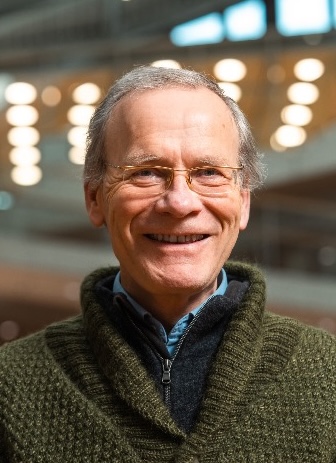
Herbert Jaeger studied mathematics and psychology in Freiburg (Germany), got his PhD Computer Science / AI in Bielefeld (Germany) and then did a postdoc at the (then) German National Research Institute for Mathematics and Computer Science (GMD) in Sankt Augustin (Germany), where he subsequently founded the research unit ‘Modeling Intelligent Dynamical Systems’ (MINDS); then from 2001 to 2019 he served as professor in the CS department of Jacobs University Bremen (Germany). Since 2019 he has been Professor for Computing in Cognitive Materials at the University of Groningen. Current research focus: mathematical foundations for a theory of computing on the basis of non-digital physical substrates. Jaeger retired in June 2025 and now has almost enough time for tackling the math-of-complex-systems riddles that got him hooked since student times.
Affiliation: University of Groningen
Homepage: https://www.ai.rug.nl/minds/