Lecturer: Ronald Sladky
Fields: Neuroscience, Cognitive Science, Modeling
Content
Originally, the idea of free energy minimization has been used as a tool for data modeling, in particular, to model effective connectivity in the brain based on neuroimaging data. On top of this, Karl Friston has proposed the free energy principle as a general principle for understanding brain functions. A bold statement – but, if true, one of the biggest breakthroughs in cognitive science.
In the form of active inference, the free energy principle could provide a neuro-computational explanation for predictive processing, the Bayesian brain hypothesis, and enactive cognition. It could provide a unified conceptual and computational framework to link previously distant and isolated research fields in the cognitive sciences that could be compatible with how we understand self-organization of living systems in a physical world.
In this course we will talk about how we make sense of data using models. By looking at how cognitive neuroscientists study the human brain using fMRI and brain connectivity methods. We discuss how models shape the way we interpret the world. I will teach you how these models work so you will find out on your own what to do with them. To what degree is the free energy principle useful for you? Modeling data, modeling the brain – or modeling the mind?
Session 1. The Hype. I will gently introduce Predictive Processing and Karl Friston’s Free Energy Principle, and how they can transform how we understand the brain and everyday experience.
Session 2. The Mechanisms. I will show you an intuitive walkthrough of the core formalism behind the Free Energy Principle, and why it’s handy for tackling specific puzzles in cognition and modeling. Predictive Processing in a Nutshell.
Session 3. The Applications. Based in my own work, I will show you how the Free Energy principle can be used to model data (dynamic causal modeling of fMRI data; hierarchical Gaussian filter for behavioral data), how it can inspire theories about the brain (active inference in the amygdala), and maybe even the mind (from hidden springs to endless oceans).
Note: The course will try to prepare you to interface with Kathryn Nave\’s SC3 – Models and Metaphysics of Living Systems (https://interdisciplinary-college.org/2026-sc3/). This was a last-minute addition to the program. Some details are subject to ad hoc changes. I will probably skip parts of this very dense lecture and give you space for discussion and critical reflection.
Literature
- Parr, T., Pezzulo G., & Friston K. J. (2022). Active Inference: The Free Energy Principle in Mind, Brain, and Behavior. FREE e-book https://mitpress.mit.edu/9780262045353/active-inference/
- Friston, K. J. (2009). The free-energy principle: a rough guide to the brain?. Trends in cognitive sciences, 13(7), 293-301.
- Marreiros, A. C., Stephan, K. E., & Friston, K. J. (2010). Dynamic causal modeling. Scholarpedia, 5(7), 9568.
- Friston, K. (2013). Life as we know it. Journal of the Royal Society Interface, 10(86), 20130475.
- van Es, T. (2021). Living models or life modelled? On the use of models in the free energy principle. Adaptive Behavior, 29(3), 315-329.
- Corcoran, A. W., Hohwy, J., & Friston, K. J. (2023). Accelerating scientific progress through Bayesian adversarial collaboration. Neuron, 111(22), 3505-3516.
- Sladky, R., Kargl, D., Haubensak, W., & Lamm, C. (2024). An active inference perspective for the amygdala complex. Trends in Cognitive Sciences.
Lecturer
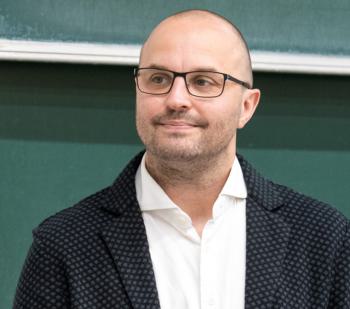
Ronald Sladky is a cognitive neuroscientist at the University of Vienna, Austria, at the Faculty of Psychology (Department of Cognition, Emotion, and Methods in Psychology). He teaches courses on cognitive science and predictive processing. His research focusses on the amygdala as well as emotion processing and social cognition in the human brain.
Affiliation: University of Vienna
Homepage: http://sweetneuron.at